Mysteries of the first language
One of the biggest mysteries of language is if a first language of humanity ever existed, or if language developped in different locations simultanously. Why do we think that a first, original language did exist? Some thirty years ago, Philologist and Linguists thought that multiforms of languages existed, that is to say, they argued that languages developed parallel to the number of cultures that came up.
How is the confusion of the languages interpreted?
Alfredo Gamarra finds that an inadequate interpretation from the texts exists. In the interpretation of Genesis 11 vers 5, it is attributed to God that he "came down to see the city and the tower that the men were building". Supposing that 'God is the Life, intelligence, and the Power that orders and regulates the Universe', it is implicit that God is everywhere, including of course being in each one of us. Thus it is an inadequate interpretation of the 'omnipresence' of God to refer to any 'coming down to see'. We believe that this derives from the inaccurate interpretation, or rather assumption, that most scientific sources imply that the Earth has been located from the initial moment of existence to the present period in the same sidereal location of the orbit of 365 days per year. It is our contention that the Earth from it's creation has had other locations in orbits closer to the Sun. As a result of which our planet, as has been postulated in Astro-physical theory, has been parted from the mass of the Sun, from where it has originally come, developing orbits of ever greater size, until being located in the present sidereal position. The same process has happened to the moon. When the manned lunar missions returned with mineral samples it could be proved that the moon has been part of the mass of the Earth. In fact, both were part of the mass of the sun.
Further to this is
a small anecdote : Alfredo Gamarra said, ten years
before the moon landings, that the moon had been torn from the earth,
his reason for believing this was that the Quechua word for the moon
was 'Jukk'iylla, which means literally "moon torn from the earth".
It is now thought that the moon was part of the earth while the earth
was forming according to the isotopes in the soil on the moon. that was
brung back by the apollo flights, it states that
the earth may have been hit by a large planet, as the isotopes are the
same as on earth.
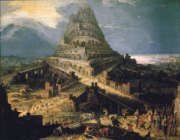
With the 'guided' investigations of Alfredo Gamarra we believe that we can identify vestigial archeological remains to support the early Biblical scenes, for example the Tower of Babel. He is able to demonstrate with the aid of eleven existing sciences and other types of new evidence, some irrefutable, that the 'Sacred Places of Origin', or what is known as the 'Cradle of Humanity', is located in what is now the South American continent. Specifically the central axis in Peru, including present day Bolivia, as being the 'Center of the Creation'. The exact central point being what we now know as the city of Cusco. It is in this region that A.G. locates the archeological vestiges of the Tower of Babel or Etemenanki, known as Sacsayhuaman from the Inca period, the most cyclopian construction of the planet. Alfredo Gamarra with his investigations denomstrates that the ancestral 'common' language of humanity comes from this region, and that in Quechua and Aymara there are, in both pure and changed ways, many of the words that comprised the 'First Universal Human Language'.
Many people, when reading this manifesto, may think that these are less than audacious opinions. However, this is not the first time that a theory has pointed to South America as the cradle of humanity. As we can demonstrate, there are data and investigations that we believe are from sensible, just and cultured personalities, whose works in the fields of Linguistics and Philology are worthy of careful consideration, from which we can distill the Origin of the First Language. We are delighted to represent those who were, in our opinion, previously unjustly underestimated and that today we can re-evaluate the meaning of the following investigations:
- Onffroy de
Thoron. In the 19th century de Thoron discovers surprising
similarities between the language Quechua or Runa Simi (=language of
man) and the Ancient Egyptian language, positing Quechua to be the
prototype of the Ancient Egyptian tongue.
- The Indians known as Los Indios Campas in the Peruvian Amazon, according to the versions of Spanish and Portuguese chroniclers at the end of the 18th century, who's spoken idiom was either similar, or even identical to the Ancient Egyptian language.
- V. Henry, published the book "Le Quichua est il une langue aryene?" (Is Quechua an Aryan Language?) in Luxembourg in 1877. In this work Henry sets out to demonstrate that Quechua is, indeed, an Aryan language, containing in great amount the Ar radical, and being of solar origin, and the prototype of the languages of Europe and Asia.
- Jorge Philips, an highly erudite German, as his position as Director of the Imperial Academy of Sciences of Vienna affirms, wrote a theory in 1870, not only based on linguistic investigations, but also on other corroborative proofs. He said that the Arrias or Arias, were the common basis of all the European and Indian civilizations, and came from the Americas.
- Philipe Marcou published in 1924 "Utilite des comparaisons entre les langues d'Amerique et langues indoeuropeenes". Marcou, finds between languages like Quechua, Aymara and Quiche much more relationship with the Indo-European languages. So knowing these American languages, one can understand without knowing them, languages from Europe and Asia.
- Fidel Vicente Lopez published in Paris, in 1871, the book "Las races aryennes de Peru" in which he deals with languages like Magyar, the Pelasgo, the Vedico and the Etruscan, coming to the conclusion that they come from ancestral languages of Peru.
Juan Moricz demonstrates, in a practical way, what is indicated by the title of his book, published in 1968: 'Origen Americano de pueblos Europeos' (American Origin of European people).- Benign Ferrario, published in 1933 the book 'La investigacion linguistica y el parentesco extra continental de la lengua Quechua' ( The linguistic investigation and the extra-continental relationship of the Quechuá language). Work that leaves without doubts the influence that has the language Quechua or Runa Simi, on Indo-European languages.
- Rvdo P. Dominicio. Ambrosio Morales, member of the seminary of High Studies of the Institute Arquelogico de Cusco in 1941, published the book 'Cusco ciudad Milenaria' (Cusco, City of the Millenia). Morales discovered that the first foundation of Cusco is done by cultures previous to the Pelasgos (proto-Greeks) who spoke a mother language Hebrew, Latin, Siriaco and whose origins are in the Quechua language.
- Juan de Velasco, publishes in the year 1844 his book titled 'Historia del reyno de Quito' (History of the Kingdom of Quito) in which he explains that the cradle of the Phoenicians was in Peru, as a result of being descendents of the Wankás, an ethnic group of North-Central Peru.
- Pablo Patron, in his important work 'Nuevos estudios sobre las lenguas Americanas' (New Studies on the American Languages) makes special and revealing analogies, concluding that Quechua and Aymara, have the same semitic origin as the Sumerian-Asirian languages.
- Alberto Childe, in 1927, makes an Philological analysis and provides other evidences on the cradle of the Tusci, Tuskos or Etruscans in his book 'Os Etruscos na americá' (The Etruscans in America), in which he demonstrates the abundant existence of the presence of the Etruscans in the South American continent.
- Mario Gattoni Celli, published in Rome 1967, his book 'Gli Etruschi della Russia all 'America''. In which he sustains an undeniable migration, when finding the prototypes of the Etruscans in America.
- Natalia Rossi de Tariffi, to this day we consider this Philological investigation the most expertised, deep and coherent, with respect to locating the mysterious cradle of the Etruscans in her work published in 1969, 'America cuarta dimension, los etruscos salieron de los Andes' ( America fourth dimension, the Etruscans left from the Andes').
- Arthur Posnansky, German archeologist, who after twenty years of archeological investigation in Tiahuanaco (Bolivia), finds vestiges from the time of the human origins and publishes in 1943 his work 'Las Americas son un mundo nuevo o un mundo mas antiguo que Europa y Asia?' (The Americas are a new world or a more ancient world than Europe and Asia?)
- Jacques de Mahieu, a precise, contemporary investigator, indicated that South America was the true scene of the 'Old Testament' accounts, as a result of it established that important architectural details of the gothic cathedrals of the Mediterranean, have their origins in the pre-Colombian architecture of South America. In the Seventies he published 'Drakkars en el Amazonas' (Drakkars in Amazonia) and 'El gran viaje del Dios Sol' ('The Great Voyage of the Sun God', 1976).
- Gene Savoy, Dr Honoris of the University of Yale, archbishop of the 'International Community of Christ' Church, discoverer in Peru of the archeological complex of the Great Pajaten. Investigator of the origin of the Egyptians in Peru, as he indicates in his work 'Antisuyo'. In 1992 he discovers in Great Vilaya, Chachapoyas Peru, lanzones of stone with hieroglyphic writings of pre-semitic data. He is of the opinion that Peru was Ophir, the distant place where king Salomon got the fine gold to constuct the Coffer of the Alliance, webpage:www.genesavoy.org
To continue we will make reference to the studies and investigations that tie the Quechua language with the Latin through Etruscan:
We also consider it very important to know that many other investigations were made on the themes of Philology and Linguistics, but also included other aspects concerning Archeology, that indicate the American location of the Cradle of Humanity and as a consequence the First Universal Language.
Modern
technology is also concurrent with the hypotheses of Alfredo
Gamarra. The modern discovery made by Ing. Boliviano Ivan Guzman de
Rojas, who has invented a software Atamiri with which it is possible to
translate up to nine languages with one translator. Being the patron
based on the languages Aymara. This important fact means for A.G. no
less than the reversion of languages to their close origins in Quechua
and Aymara, languages that developed in the location where the
'Creation' took place, containing varied or pure, many words of the
first language. This language has to be called ARAC, that means just
like Adam in Hebrew, Humanity. Because of the volume of the material as
to why the first language was called Arac, this will be done in a
further paper. It is also significant that Graham Hancock in his book
Fingerprints of the Gods recognizes Aymara as one of the remote human
antiquities, something in which we also believe, besides which it is
consequent that the oldest languages are not likely to be distant from
the cradle of humanity.
Return to top